Closing the Execution Gap: The Path to the Autonomous Enterprise.
Enterprises have invested heavily in systems that record, analyze and increasingly predict business activity. But becoming an Autonomous Enterprise requires something more fundamental: turning intelligence into action.
For decades, organizations have invested in technology to improve how their businesses operate. ERP systems have standardized processes. Analytics platforms have made performance more transparent. Automation has eliminated repetitive tasks. And now AI promises to transform how organizations make decisions and execute business processes.
Yet despite these investments, many organizations continue to struggle with a fundamental problem: the distance between what their enterprise systems enable and how work actually gets done.
Employees still navigate complex applications, transfer information between disconnected systems, rely on spreadsheets and manual workarounds, and spend valuable time coordinating activities that should flow seamlessly.
This is what we call the Execution Gap.
And it represents more than an operational inefficiency. It is also one of the biggest obstacles on the journey toward the Autonomous Enterprise, where people, systems and AI work together to execute business processes with increasing intelligence and autonomy.
We have become better at seeing problems than solving them.
A revealing perspective comes from Innovapptive’s Frontline Execution Benchmark 2026, which examines operational diagnostics from approximately 120 plants and sites across 22 organizations and seven industries.
The research highlights a striking disconnect between investments in operational visibility and the ability to translate that visibility into effective action.
At one chemicals plant, technicians spent just 22% of their time performing hands-on work, while 44% was consumed by potentially avoidable waiting, including delays related to parts, permits, information and coordination.
At another plant, approximately 20 hours per week were lost to re-keying information and handling failure codes across disconnected workflows.
And at two chemicals plants, corrective maintenance work took approximately 100 days from creation to closure.
These are observations from individual facilities, not industry-wide averages. Nevertheless, they illustrate an important structural problem.
Knowing what needs to happen is not the same as making it happen.
Enterprise technology has become increasingly effective at capturing transactions, identifying problems and generating insights. But between recognizing an issue and resolving it, work must still move between people, applications, departments and systems.
Every unnecessary handoff, manual intervention and disconnected workflow creates friction. And that friction has a cost.
An Autonomous Enterprise cannot emerge from this fragmented execution model simply by adding more intelligence. It first needs a reliable way to turn intelligence into coordinated action.
The hidden economics of the Execution Gap.
The consequences of inefficient execution extend far beyond employee frustration or poor user experiences.
They affect operational performance, workforce productivity and ultimately profitability.
Consider three ways the Execution Gap creates economic value leakage.
1. The cost of work that doesn’t flow
When employees cannot access the information, applications or processes they need in the context of their work, productivity suffers.
A maintenance technician waiting for a permit, a warehouse operator switching between systems, or a purchasing specialist repeatedly entering the same information all experience different versions of the same problem.
Their enterprise systems may be functioning exactly as designed. But the work itself is not flowing efficiently.
The Innovapptive benchmark illustrates the scale of this challenge. At one chemicals plant, 44% of technician time was spent waiting on issues the researchers considered addressable.
The opportunity is not simply to make existing interfaces more attractive. It is to redesign execution around the work people need to accomplish.
2. The cost of mistakes and rework
Inefficient processes do not just consume time. They increase the likelihood of incomplete work, errors and repeated activities.
In one food manufacturing network examined by Innovapptive, approximately 36% of maintenance costs were associated with repeat breakdowns. Preventive maintenance compliance was reported at 96% to 97%, yet equipment continued to fail.
This exposes a critical distinction between completing an activity and achieving the intended outcome.
A task can be marked complete in an enterprise system without the underlying problem being resolved.
Closing the Execution Gap requires more than digitizing activities. It requires ensuring that work is completed correctly, outcomes are verified, and the organization learns from what happened.
That learning becomes even more important as AI agents take on a greater role in business execution. Autonomous actions are only valuable when they consistently produce the intended outcomes.
3. The cost of compensating for inefficient execution
When processes do not work efficiently, organizations often compensate by adding capacity.
More employees. More overtime. More contractors. More manual coordination.
The benchmark found that corrective maintenance jobs cost approximately five to eight-and-a-half times as much as planned jobs at three plants.
At one consumer manufacturing plant, technician headcount increased from eight to 34 while overall equipment effectiveness improved only modestly.
The lesson extends beyond manufacturing.
When organizations cannot improve how work gets done, they often end up paying more to get the same work done.
And that makes the Execution Gap a business performance issue, not simply an IT problem.
The missing layer between enterprise intelligence and execution.
Most large organizations already have substantial technology investments.
Systems of record, such as SAP, manage core business processes, transactions and data. Systems of insight provide analytics, monitoring and increasingly AI-powered intelligence.
Both are essential.
But neither automatically guarantees that work gets executed efficiently across the organization.
Consider a frontline employee who needs to identify an issue, retrieve information from SAP, coordinate with another department, update a work order, and confirm that the problem has been resolved.
Each individual system may support part of that process. Yet the employee is still responsible for connecting the pieces.
This is where a different approach is needed.
An Execution Platform connects enterprise systems, business processes, people and AI around the work that needs to get done.
Rather than forcing employees to navigate the complexity of underlying systems, it provides fit-for-purpose business applications that bring relevant information and actions together.
As AI becomes part of enterprise operations, this execution layer also provides the foundation for agents to participate in business processes, working alongside people and acting within established business rules.
The objective is not to replace existing enterprise systems. It is to make those investments more valuable by improving how work happens around and within them.
For SAP-centric organizations, this distinction is particularly important.
SAP remains the trusted foundation for core processes, business logic, data and authorizations. The opportunity is to make that foundation easier to act upon, without unnecessarily duplicating business logic or introducing additional complexity. scale from there. Asia Express Food took its first warehouse application from idea to production in four days on SAP ECC. Johnson & Johnson scaled an inventory management application to 16 sites and 130,000 users and cut SAP supply chain processing time by 40%. In Warehouse Operations, customers see up to 30% faster inventory counting.
From better applications to increasingly autonomous
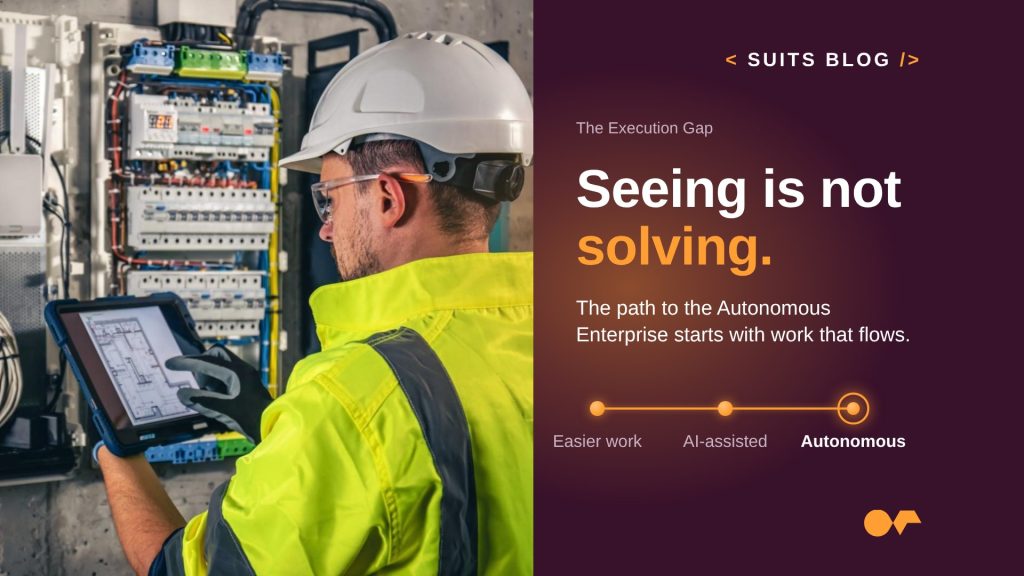
The journey toward the Autonomous Enterprise is not a single technology implementation. It is a progression in how work gets done.
It starts by making everyday work easier for people. Fit-for-purpose applications simplify complex processes, bring together information from multiple systems, and enable employees to complete tasks wherever work happens.
The next step is making execution more intelligent. AI helps employees understand context, identify issues, make decisions and complete tasks with less manual effort.
As organizations build confidence and establish appropriate controls, AI agents can begin taking responsibility for defined business actions and coordinating activities across systems.
Eventually, more processes can operate with increasing autonomy, while people retain oversight of exceptions, critical decisions and outcomes.
Consider how this could change a maintenance process.
Today, an equipment issue might be detected automatically, but still require multiple people to interpret the alert, coordinate the response, prepare a work order and organize corrective action.
In a connected execution environment, the relevant information and actions are brought together for the people responsible for resolving the issue.
With AI assistance, the system could help assess the problem, identify the appropriate response and prepare the necessary work.
With greater autonomy, an AI agent could execute authorized steps, coordinate activities across enterprise systems and escalate exceptions that require human judgment.
The underlying business systems remain in place. What changes is how intelligently and efficiently work gets executed.
The Autonomous Enterprise is not about removing people from business processes. It is about removing unnecessary friction, while allowing people and AI to contribute where they create the most value.
Why AI alone will not close the Execution Gap
AI is advancing rapidly. Organizations can already use it to generate applications, interpret information, automate tasks and interact with enterprise systems through natural language.
But adding AI to fragmented processes does not automatically make those processes more effective.
An AI agent that identifies a maintenance problem but cannot act on the underlying business process creates another layer of intelligence without resolving the execution challenge.
Similarly, an agent that can initiate transactions without understanding established business rules, authorizations or process dependencies introduces new risks.
For AI to deliver meaningful operational value, it must connect intelligence with trusted execution.
That means AI agents need access to relevant business context, the ability to invoke approved business actions, and clear boundaries for what they can do independently.
It also means applications and AI agents must work together.
Applications provide people with the experiences they need to perform and oversee work. AI agents can help prepare, coordinate and execute actions. Enterprise systems continue to govern the underlying transactions, business logic and data.
This combination creates a practical foundation for increasingly autonomous operations.
Without connected execution, AI risks becoming another technology that tells organizations what they should do, rather than helping them get it done.
The next phase of digital transformation is execution transformation
For years, digital transformation programs have focused on implementing new systems, modernizing applications and improving access to information.
Those investments remain important, but they are not sufficient.
The next question should be:
How effectively does our organization turn information, decisions and business processes into completed work and measurable outcomes?
Instead of measuring only system availability, transaction volumes or application adoption, organizations should examine how work actually flows.
How long does it take to move from identifying a problem to resolving it? How many systems and manual steps are involved? How much employee time is spent waiting, searching or re-entering information? How often does work need to be repeated?
And critically, what do those inefficiencies cost?
These questions establish a baseline for execution improvement. They also help organizations identify where AI can deliver real value, rather than simply introducing automation for its own sake.
The path toward the Autonomous Enterprise begins by eliminating the friction that slows people down today.
It continues by connecting business processes across enterprise systems, embedding AI into everyday work, and progressively enabling AI agents to execute increasingly complex activities within established controls.
Each step should deliver measurable business value, independently of how autonomous the organization eventually becomes.
The Autonomous Enterprise will be built on better execution
The enterprise technology landscape is changing rapidly.
AI will make it easier to develop applications, access information and automate individual tasks. But those capabilities alone will not determine which organizations achieve the greatest business value.
The differentiator will be how effectively organizations translate their technology investments and AI capabilities into operational performance.
That means connecting the systems they already depend on with the people and AI agents responsible for getting work done.
At Neptune Software, we believe this is the opportunity behind the SAP-native Execution Platform: closing the gap between enterprise systems and business execution, while building on the trusted processes and investments organizations already have.
Our vision is a world where work flows effortlessly between people, systems and AI.
And the journey toward that vision is practical: make work easier today, make execution more intelligent tomorrow, and progressively enable the autonomous operations of the future.
Because ultimately, the Autonomous Enterprise will not be defined by how much AI an organization deploys, but by how effectively its people, systems and AI work together to deliver business outcomes.