Most enterprise AI still stops at the recommendation. It summarises, it suggests, it drafts — and then someone still has to open SAP and do the work by hand. The next step for AI for SAP is a system that can act on enterprise data, not just describe it. That only works with the governance and audit trail that make the result trustworthy.
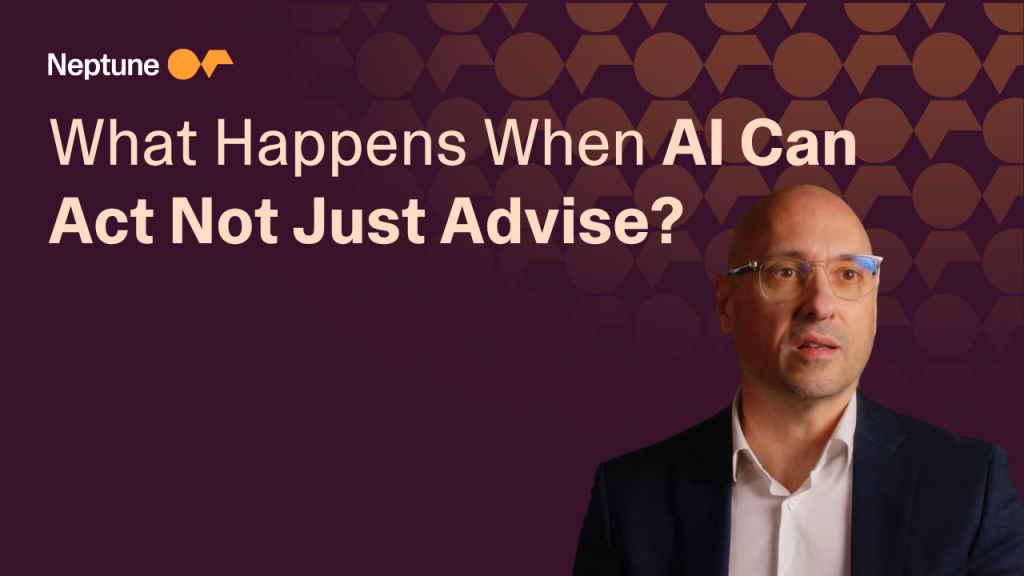
In this short video, Neptune Software Chief Product Officer Helder Goncalves explains how an MCP-based intelligent layer lets AI agents read and write across SAP ECC and S/4HANA securely. He also covers why context-adaptive apps change the way enterprise software gets built. And he sets out what it means when the enterprise becomes a self-optimising system, with humans still in control.
“SAP has always been great at storing and processing data. But now AI is turning it into a system that can actually act on that data.”Helder Goncalves, Chief Product Officer, Neptune Software
Key takeaways
- Advice is not execution. Enterprise AI only pays off when AI for SAP becomes part of how work actually gets done, not a layer of suggestions bolted on top.
- Governed access to the SAP core. Neptune’s MCP-based intelligent layer lets AI agents read and write across SAP, ECC and S/4HANA securely and with full governance.
- Context-adaptive apps. Human, AI and interface sit in the same conversation, and both the person and the agent can update the UI in real time.
- Agents, not just apps. Agent-callable tools and AI-native process orchestration shorten the path from an idea to a working solution.
- Timing is a cost. Organisations that build an AI-powered operations layer on their existing SAP core now avoid accumulating more technical debt later.
Why AI for SAP has to act, not just advise
For most organisations, the first wave of enterprise AI landed next to the business process rather than inside it. Copilots draft, chatbots answer, dashboards explain — but the transaction still gets posted by a person. That gap is where the value leaks out, because every recommendation still costs a human handover.
SAP is where that gap is most expensive. It holds the master data, the orders, the stock and the financials that the rest of the business depends on. It has always been strong at storing and processing that data reliably. What changes with AI for SAP is the ability to close the loop. An agent can now read the situation and take the next step within it, under the same controls a person would be held to.
A governed intelligent layer across SAP ECC and S/4HANA
Neptune’s approach to AI for SAP is an intelligent layer built on the Model Context Protocol (MCP) that gives AI agents structured, permissioned access to SAP, ECC and S/4HANA. Agents can read and write across those systems, but every action runs inside defined guardrails, and every interaction is traceable.
That governance is what makes enterprise AI viable in a production landscape rather than a proof of concept. Security, auditability and freedom of choice over models are not features added at the end. They are the reason a business can let an agent touch a live SAP process at all. Neptune’s Naia AI capabilities apply the same principle across development, business-user access and agent orchestration.
From static apps to living systems
The longer-term shift is in what an application is. Neptune’s vision is context-adaptive apps: intelligent applications where the human, the AI and the interface are all part of one conversation. Both sides can update and interact with the UI in real time. On top of that, agent-callable tools and AI-native process orchestration make it possible to build agents rather than only apps.
Applications start to behave less like static interfaces and more like living systems. Think apps with embedded agents that detect a problem and act on it as it happens. The enterprise becomes largely self-optimising, with fewer humans in the loop but humans firmly in control of the guardrails.
The window matters. Companies that move now can build an AI for SAP operations layer directly on top of the SAP core they already run. Those that wait will keep accumulating technical debt around it — and fall further behind the ones that did not. Enterprise AI rewards the organisations that put it into production, not the ones that pilot it indefinitely.