
AI for SAP: Why 95% of Pilots Never Reach Production.
The execution gap is structural, not technical.
Most enterprise AI projects do not fail because the models are wrong. They fail because of where the AI lives.
Boards have signed off on AI budgets. Pilots have launched. Proof-of-concepts have been demoed to applause. And yet, most of those pilots are still pilots. The investments that were supposed to transform operations are sitting in sandboxes while costs rise in the core business.
The numbers make it concrete:
- 95% of custom enterprise AI solutions fail to reach production
- 23% of organizations are actually scaling AI across the business
- <10% of SAP customers run AI-augmented processes in daily operations
Across industries, 88% of organizations use AI in at least one business function, but only 23% are actually scaling it. Just 1% of companies believe they are at AI maturity, according to McKinsey’s 2025 global survey. The rest are stuck in what industry observers call pilot purgatory: endless cycles of promising demos that never quite make it to the workflows where work actually happens.
That is the AI execution gap. And if you are running AI for SAP, it is where your next 18 months will either be won or quietly lost.
The usual explanations miss the point
When AI initiatives stall, the postmortems tend to blame the same things: data quality, talent gaps, unclear ROI. All three are real. None of them explain why so many technically sound pilots still fail to become operational capabilities.
Teams ship working models that never make it into production. Prototypes that demonstrated clear value get stuck in security review, or in middleware procurement, or in the gap between what a Python notebook can do and what a business process actually needs. The AI worked. It just had nowhere to go.
AI creates value when it becomes part of how work gets done, not when it lives beside it.
The real barriers are structural. Four of them, in the order they usually bite:
- Legacy complexity. 91% of SAP customers rely on custom ABAP code to run essential business processes. That is not a defect; it is how enterprises actually work. But it means AI cannot simply be plugged in. Every data structure is unique, often undocumented, and tightly coupled to decades of business logic.
- Siloed data. 60% of AI initiatives fail due to data quality, availability, or integration issues (McKinsey, 2025). The problem is rarely that companies lack data. The problem is that the CRM knows about customers, the ERP knows about orders, the maintenance system knows about equipment, and no single layer connects them in a way AI can access in real time.
- Governance gaps. Only 21% of organizations have enterprise-level AI governance. Meanwhile, 76% cite data privacy and security as their most concerning AI risk. Result: business teams want to move fast, IT and compliance have no framework to say yes safely, and the pilots that get approved are the ones that do not move the needle.
- AI not embedded in workflows. This is the barrier that matters most, and the one that gets the least attention. A chatbot here. A dashboard there. A predictive model that spits out scores nobody knows what to do with. Every Alt-Tab between insight and action is a place where value leaks out.
The first three are real. The fourth is the reason the first three are fatal. AI that lives beside work does not survive contact with operations. AI that lives inside work does.
What changed: from copilots to agents
Something shifted in enterprise AI over the past year. The conversation moved beyond chatbots and copilots toward a different kind of capability: AI agents that do not just suggest, they execute.
Autonomous Agents and Agentic AI surged 31.5% year-over-year as a top technology priority among enterprise IT decision-makers (Futurum, 2026). It is now the fastest-growing category in enterprise software.
The distinction between a copilot and an agent is not semantic. A copilot watches you work and offers suggestions. An agent works alongside you, handling tasks within boundaries you define. The copilot says “you might want to check this order.” The agent checks the order, identifies the problem, and resolves it, or escalates it to you with context already gathered.
Autonomy does not mean uncontrolled automation. It is delegated authority, exercised within a governed platform.
This matters for the execution gap for one reason: copilots require someone to be present, watching, clicking. They help individuals. Agents can work in the background, handling the high-volume, time-critical processes that eat operational bandwidth. They change operations.
But agents need a home. They need to live inside the applications where work happens, connected to the data they need to reason about, governed by the policies that keep the enterprise safe. Without that home, they are just another set of demos.
Why AI for SAP is where this gets concrete
For the 90%+ of Fortune 500 companies running SAP, this is not an abstract technology decision. It is a question of how to bring intelligence into the systems where mission-critical processes already run.
SAP itself has moved aggressively. The company now offers 350+ AI features, including Joule (its conversational assistant) and over 2,400 Joule skills embedded across S/4HANA, SuccessFactors, Ariba, and Concur. At SAP Connect 2025, it unveiled 14 new Joule Agents spanning finance, HR, procurement, and supply chain. Joule Studio, which lets businesses build custom agents with low-code tooling, became generally available in Q1 2026.
The ambition is real. The feature velocity is high. And most SAP customers cannot use these capabilities today.
The uncomfortable reality
60% of companies currently migrating to S/4HANA consider themselves not agile, efficient, or flexible enough to adopt Joule alongside their ERP transition (Horváth, 2025). Fewer than 10% of SAP customers run AI-augmented processes in their daily operations. The technology exists. The integration across most real-world landscapes does not.
SAP’s native AI works best on a clean core: an S/4HANA environment with minimal customization and standardized data structures. But 91% of SAP customers run custom code, often spread across ECC on-premise, S/4HANA Cloud, and satellite SaaS. The very customizations that made SAP valuable to the enterprise also make it harder to adopt SAP’s native AI.
Add the 2027 ECC mainstream support deadline and the equation is stark: most enterprises cannot wait for a big-bang migration to start extracting AI value. They need to do both in parallel.
What the 5% do differently
There is another side to the data. The companies that move AI from pilots to production-scale processes report an average 1.7x ROI on AI investments. The numbers they post are not small:
- 27% average productivity improvement across measured use cases.
- 11.4 hours saved per knowledge worker per week.
- $8,700 in annual efficiency gains per employee.
- 26 to 31% cost savings in supply chain, procurement, finance, and customer operations.
The common trait across these companies is not better models or more data scientists. It is a different starting assumption. They have stopped treating AI as a standalone initiative and started treating it as an operational capability. They have moved from copilots that assist to agents that execute. And they have invested in platforms that connect AI to the systems where work actually happens.
The measurement shift reflects this. In 2024 and 2025, productivity gains were the default justification for generative AI investments (23.8% of enterprises named it as the primary ROI metric). By 2026, that fell to 18.0%, while direct financial impact (revenue growth and profitability combined) nearly doubled to 21.7% (Futurum, 2026). Boards are no longer impressed by time saved. They want money made.
Why platform-based AI scales and fragmented AI does not
A platform is not just another tool. It is the orchestration layer that makes AI operational. Five things separate a platform from a patchwork:
- Direct data access: real-time connection to SAP and other systems of record, with governance and security inherited from the enterprise.
- Unified development: a single environment where teams build applications, connect AI services, and deploy to production. No middleware, no context switching.
- Embedded AI: the ability to bring AI capabilities directly into the screens where work happens, not as a separate tool but as part of the workflow.
- Enterprise governance: every model, prompt, and parameter tracked in one audit trail. Compliance that scales automatically, without throttling creativity.
- Lifecycle management: versioning, access control, monitoring, and controlled rollout from development to production.
The integration is where AI earns its keep. A predictive score embedded in a purchase order. A chat answer inside a maintenance ticket. An exception resolution agent that surfaces in the order management screen with context already gathered. That zero-friction handoff, not another standalone dashboard, is what moves the P&L.
Fragmented AI tools fail. Platform-based AI scales. Copilots help individuals. Platforms change operations.
The governance argument is about to get sharper. The EU AI Act becomes enforceable on August 2, 2026, with fines up to €35 million or 7% of global annual revenue for high-risk AI violations. Over half of organizations lack systematic inventories of the AI systems already in production. A spreadsheet tracking which teams use which tools does not scale. Not with that deadline approaching.
Where Neptune fits
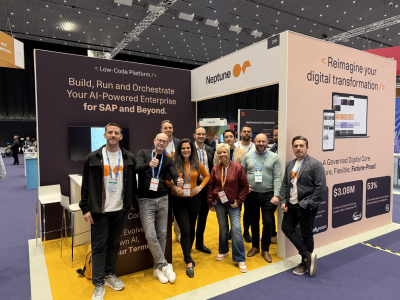
Neptune Software builds the orchestration layer for enterprises that need AI to run inside SAP. Neptune DXP is certified for SAP S/4HANA Cloud clean core, runs natively inside ECC and S/4HANA on-premise, and extends to non-SAP systems through a single governed environment. 600+ customers and more than 4 million licensed users use it to build, deploy, and govern applications, including AI agents, without middleware and without waiting for a full migration.
The company was founded in Oslo in 2011 and is recognized by Gartner and G2 as a leader in the SAP application development space. More than 100 certified partners implement it globally.
That is the product context. What matters for the argument in this post is that the execution gap is solvable, and that solving it means bringing AI to where work already happens, under a governance model the enterprise can actually live with.
The execution era
The AI hype cycle has run its course. Boards are no longer impressed by demos. They want to see AI in production, delivering measurable results, governed properly, scaling across the organization.
The execution gap is real, but it is not inevitable. The companies breaking through share three traits. They treat AI as an operational capability, not a standalone initiative. They have moved from copilots that assist to agents that execute. And they have invested in platforms that connect AI to the systems where work actually happens.
Everyone else is still running pilots.
“The real magic of AI is not in models or math. It is in the moment a leader decides faster, with data whispering the next move before anyone else sees it. ” Andreas Grydeland Sulejewski, CEO, Neptune Software
The question is no longer whether to invest in AI. It is how fast you can close the execution gap, and whether you will be leading your industry or chasing it.